
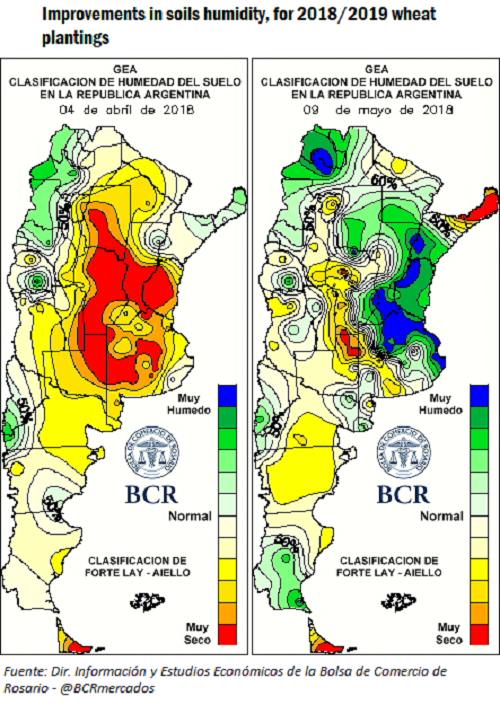
The producer´s need to quickly recover funds after a coarse grains campaign seriously injured by the drought, and the interest to maintain the rotation scheme of the crops, support the interest to plant wheat. In addition, the price offered for the new season's cereal closes the cost equation, with values as of January 2019 that are in the range of US $ 190 to 200 / t, when at the same height last year the producer was ready to sow with harvest prices around US $ 155 / t. The last stumbling block that interfered with the intentions of adding acres planted with wheat this winter, which was the lack of moisture in the soils, was left behind, after during the month of April and so far in May the worst drought of the last 50 years was abruptly interrupted. The map that is presented compares the situation at the beginning of April with the condition of the soils at May 9, and it is evident that moisture profiles were recomposed in almost the entire Argentine territory, with the exception of western Cordoba, north of La Pampa and south-center of Buenos Aires.
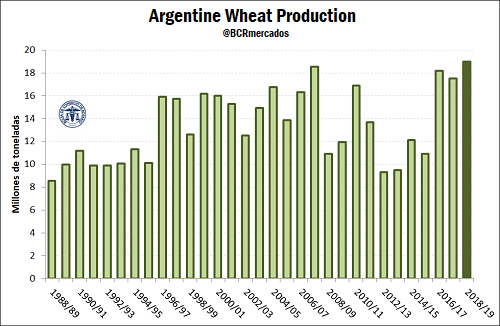
 Under the current conditions, the market consensus suggests that the area sown with wheat in Argentina next season 2018/19 will increase with respect to the 5.5 M ha of the previous year to its highest value of the last decade around the 6 M ha, according to the average expectation of the market. In terms of yield, it exhibits a clearly upward trend in recent years linked to the greater application of technology and a more careful management of the crop, which has ensured record levels of productivity during two consecutive years. Assuming a trend yield for the last 10 years, this would reach 32.9 qq / ha in the new marketing year, something above the average of the last five seasons. With these variables and taking an average lost surface, the production of Argentine wheat 2018/19 would be able to reach 19 million tons, the largest volume in the history of our country and half a million tons above the previous record, reached in 2007/08.
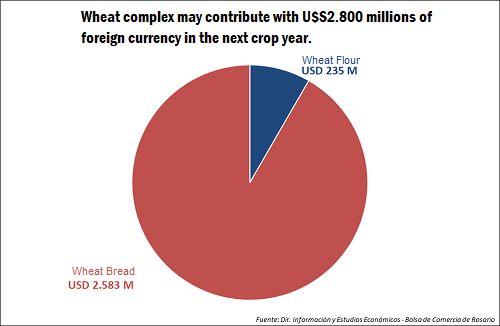
 At the current prices of wheat for January 2019 and which average US $ 190 to 200 / t in our area, this represents a contribution to the Argentine GDP of US $ 3,800 million, an important figure. At the same time, considering a stable internal consumption of mill products, the estimated volume of production would enable exports of around 12.3 million tons, very close to the historical record of 12.8 Mt achieved in 2016/17. With these numbers, plus another 700 thousand tons of flour that could be exported, this means that the wheat complex would be in a position to contribute foreign currency for some US $ 2,800 million during the 2018/19 commercial year. A very important value.
 To sum up, the productive sector is getting ready -both by its own needs and favorable signals from the market- to match the amount of hectares covered with wheat that Argentina had 10 years ago. That effort, if weather accompanies, could result in next summer´s largest production volume in the history of the country, production that will result not only in literally bringing bread to the table of all Argentine inhabitants but also in greater activity, employment and exports to contribute to the sustainable growth of our Nation.