
USA and China threaten with a trade war and the soybean market trembles
BLAS ROZADILLA - EMILCE TERRÉ
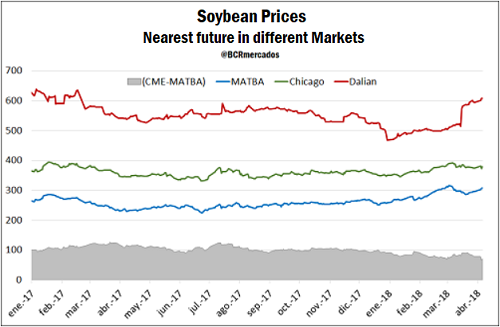
When the United States announced that they would study the feasibility of applying tariffs on 1,300 products from Chinese origin, affecting a market valued at US $ 50,000 million, the Asian country struck back warning that it would apply an equivalent commercial policy on more than 100 American goods including, among others, soybeans, corn, wheat, cotton, meats, etc. At the moment, the option to give a step back seems to be left behind when the US Executive replied with the announcement that it would consider expanding the flow of imports taxed to US $ 100 billion. Although the effective application of these measures is still subject to negotiation, the Beijing decision generated an opposite price movement in soybean prices in the United States reference market (CME Group) and in the Argentine MATba. Thus, while the oilseed was devalued in North America right after the news, the Argentine domestic price of the bean was appreciated, as can be seen in the attached graph. Thus, the gap of the nearest future position between both markets fell by more than 20% in just 15 days.
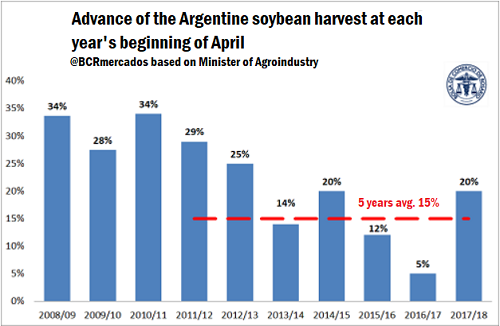
 At the same time, the Rosario Board of Trade's reference price rose to above AR $ 6,000 / t for the first time in a month and closed on Thursday in AR $ 6,200 / t, 5% above the previous week. With this, the local market recovered dynamism in relation to the previous weeks. This rise, in addition, occurs in the middle of a strong advance of the harvest in Argentina. According to the Ministry of Agribusiness, in the week to April 5, 20% of the area sown in Argentina was trilled, with an advance of 8 p.p. compared to the previous Thursday. This is well above 5% last year, 12% of the 2015/16 season (both affected by severe rains at the time of threshing) and 15% average for the last five years.
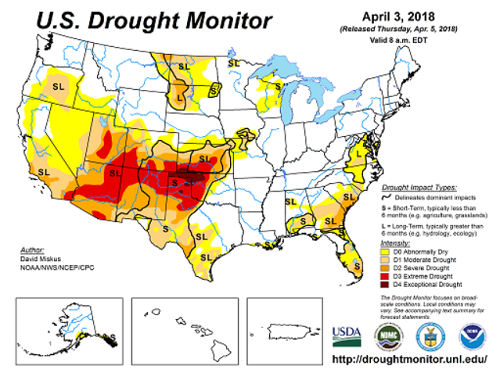
 Although the South American bean has suddenly become a more valuable product, it will not be enough by itself to supply the demand of the Asian giant, especially in a difficult campaign for our country as it is today. Altogether, exports of soybean from Brazil, Argentina and Paraguay to all destinations are at 85 million tons, when only China imports close to 100 million tons. Except that the destination matrix of use of the three mentioned countries changes, the Eastern nation will have to, clearly, continue buying in the short term part of its supply to the USA, even in spite of the overprice that the tariff will mean, if it becomes effective. Thus, the convenience for China to change the soybeans origin will depend on the relation of relative prices between the North American and the South American grain, once discounted the greater tax of the first one with respect to the greater cost of maritime freight of the second one. To close this issue and as a warning light, it is worth clarifying that a real trade war between the two main powers of the world does not open an encouraging picture for global growth in general or for the Argentine economy in particular. It is necessary to remember the times in the past when the world turned to protectionist policies, with an increase in prices of basic goods and a drop in international trade. Changing subject, the publication of planting estimates in North America that the Department of Agriculture (USDA) published last week continues to give some support to soy, and although the week closes in decline, the fall has been somewhat lower than the minimum reached in the days of negotiation. According to the USDA report, the area to be planted this year would amount to 36 million hectares, below both the 36.2 million hectares in the 2017/18 season and the almost 37 million hectares that, on average, the operators expected, according to a survey by Thomson Reuters (TR). In this way, the hope that the largest US production would compensate for the drop in production in Argentina was overturned and the market becomes much more dependent on the progress of the climate in the Northern Hemisphere for the rest of the year, especially when its starting point is not auspicious. According to official US data, almost half of the American territory has some degree of water deficit and 25% is between severe and exceptional conditions of drought.
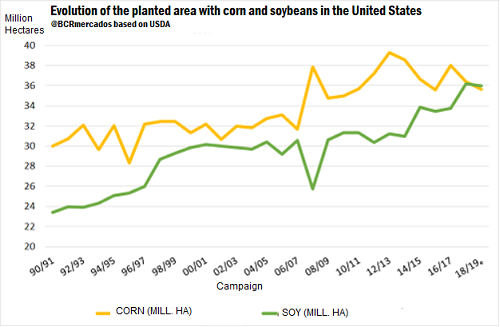
 On the other hand, the smallest area planted with soybeans in 2018 would not be offset by an increase in the area of corn. According to the USDA, the cereal will cover 35.6 million hectares, almost 1 M less than the previous production cycle and 0.6 M below the average market expectation, according to the TR survey. Thus, for the first time in history, the US are prepared to plant more soybean than corn in the new agricultural campaign 2018/19, as can be seen in the attached graph.
 Faced with the news, the nearest corn future in the CBOT increased by 4% or US $ 5.6 / t on last week's Thursday to adjust to US $ 152.7 / t. In Rosario, corn closes a positive week in prices. The price on Thursday reached AR $ 3,500 / t, AR $ 140 / t over the previous week. The export sector's needs explain most of this rise, with shipments scheduled for the next 15 to 20 days from the ports of the "Gran Rosario" by 1.4 Mt. In addition, to Thursday there already 625,000 tons Sworn Statements for new sales abroad had been presented, doubling last week figures, and 15% more than the accumulated two weeks ago. In conclusion, although the harvest of the first-planting corn in the Argentine core región already covers 88% of the area with yields that in some cases surprise positively, averaging 9 tons per hectare, the state of the corn planted later continues to be worrisome and the average estimated yields are 5 t / ha, with lots that have already been abandoned.