
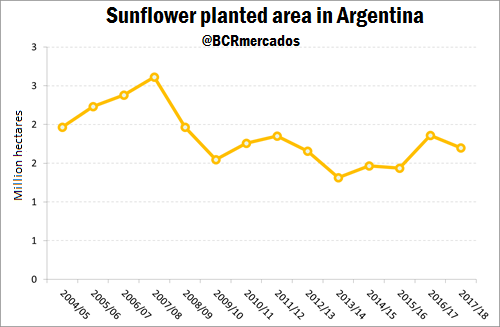
Argentina used to be the world's second largest sunflower producer, after the European Union, but in 2003/04 cycle the country fell to the fourth place, being overtaken by Russia and Ukraine. However, the main setback for the crop took place in 2007/08 season when commercial conditions strongly tilt the balance in favor of soybeans, and sunflower production was reduced to marginal areas. The decrease of sunflower planted area continued until 2013/14, when its share in the country's total started to grow. The recovery, however, did not achieve the number of hectares planted 10 years ago. In 2017/18 cycle, nevertheless, sunflower crops in Argentina showed a setback and fell by 9% compared to the previous year, totaling 1.7 million hectares.
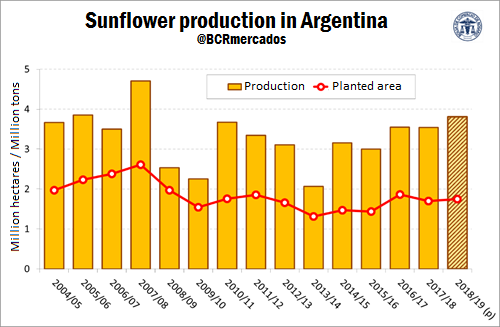
 It is noteworthy, that despite the fall in sunflower planted area, the crop showed great resilience when facing the worst drought in the past 50 years. The 21.1 qq/ha average yield, that was in line with best historical records, resulted on an unchanged production of 3.5 Mt.
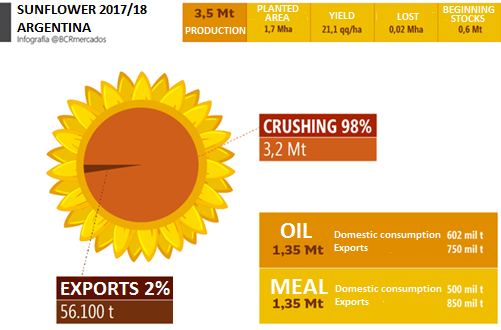 As for the demand, crushing activity is expected to achieve last year's volume, at best. According to the Secretariat of Agribusiness, 2.6 Mt have been processed between January and September this year, while in the same period last year the crushing reached 2.76 Mt. Consequently, in order to achieve a 3.2 Mt crushing, local industries should process about 600,000 tons in the last quarter. Although this crushing pace has been accomplished in the past, it has not been achieved in the last six years. Nevertheless, given the expected decline of soybean crushing, sunflower processing might benefit from the spare crushing capacity and recover. Sunflower seeds exports represent only 2% of the total production, while sunflower by-products exports is much more relevant to the complex. Sunflower oil and meal production could reach 1.35 Mt each and around 56% of sunflower oil is exported along with 60% of sunflower meal. Moreover, human consumption of sunflower oil in Argentina is relatively high. As for the new cycle's prospects, sunflower planted area is estimated at 1.75 million hectares, 50,000 more than in the previous year. Production in 2018/19 might reach the 3.8 Mt, the largest volume in a decade.
 Purchases of 2018/19 sunflower crop remain behind the past two years records, in line with the forecast of a greater worldwide supply and weakened prices. Purchases for industrial use and exports reach 186,000 tons, 36% less than the previous year and 26% below new sunflower crop purchases by October 2016. Sunflower complex prices were in a bullish trend until the beginning of September, since then the trend reversed due to the high volatility of the exchange rate. Last week, however, sunflower price recovered up to US$ 260.6/t on Thursday, which represents a weekly increase of 5%.