Projections on 2018/19 corn arrivals at ports in the Rosario Hub
FRANCO RAMSEYER - DESIRÉ SIGAUDO – EMILCE TERRÉ
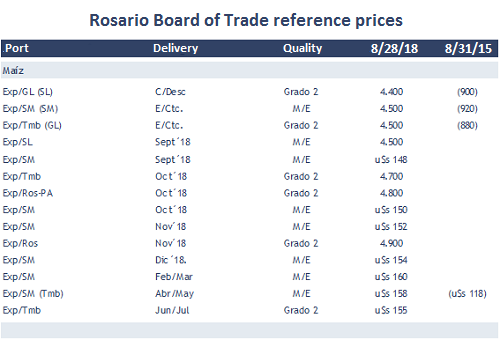
After the elimination of the existing export quotas system and the removal of export taxes that allowed farmers to improve their margins, corn export market recovered its fluidity. A more certain framework in the local market promoted the cereal's production. This greater commercial dynamism can be observed by comparing Rosario's Board of Trade reference prices in August 27, 2018 with the prices available 3 years ago, on August 31, 2015. Currently, there is not only a greater number of buyers interested in corn, but also a wider range of suppliers in the forward segment.
 Favorable business environment encourages farmers to produce corn, resulting on a planted area of 6.8 million hectares in the 2018/2019 crop. This area would constitute an unprecedented record and would represent a 51.3% increase when compared to 2014/2015 crop. The growing participation of cereals (as wheat planted area also increased in the past years) favors crop rotation that improves soil's structure, contributes with organic matter, nutrients and stubble of greater volume, it protects soil against water erosion and it helps ending some diseases cycles. Nevertheless, the new export tax scheme introduced this month might be an important drawback to the increasing corn planted area as it significantly affects corn production. Therefore, farmers might opt for planting soybean instead of corn, as the oleaginous margins turn out to be better than the cereal's. Due to the intensification of corn cultivation, exports projections for 2018/19 crop are around 26 million tons, equaling 2016/17 crop record. Rosario Board of Trade estimates that 21.5 MT of these exports will be shipped from ports located in the Rosario Hub. This volume would be 26.7% higher than previous estimations for the current crop and 1.7% higher than 2016/17 exports. It is worth mentioning that corn was one of the most affected crops during the severe draught that hit Argentina last year, thus it was expected that the export volume this season would be significantly higher.
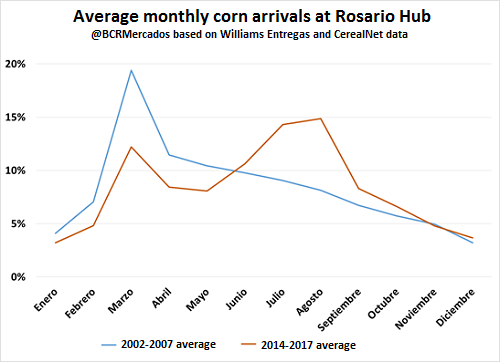
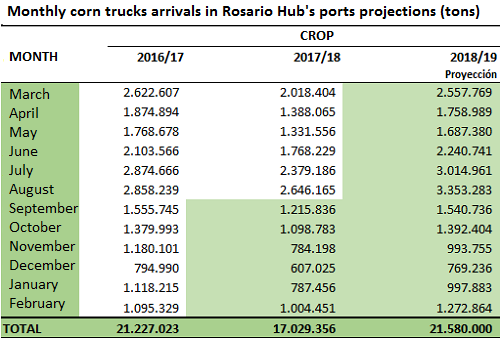 Over the last years, the arrival of corn in Rosario Hub's ports does not present the seasonal variations it used to have. In the past, the majority of trucks arrived between March and May (after the first harvest) while today the busiest months are July and August. This change responds to the growing importance of second corn crop over the past seasons. It is expected that during the 2018/19 crop, 40% of corn would arrive between June and August (after the second crop), while in March, April and May only 28% of the total volume will enter the ports. The remaining 32% would arrive between September and February. The graph compares average monthly corn trucks arrivals in Rosario Hub's ports during 2002-2007 period with monthly averages for 2014-2017 period. In 2002-2007 crops, corn arrivals reached a peak in March that represented 19% of annual deliveries. In 2014-2017 period, although March is still a key month in terms of corn deliveries, it only represents 12% of the annual total. The volume of corn entering the ports in July and August, despite being already important in previous cycles (8% and 9% for 2002-2007 average), is now higher than March volume; 14% of annual deliveries take place in July and 15% in August (2014/2017 average). Therefore, there are two important moments in terms of corn arrivals: after the first harvest in March, and after late harvest on July and August.