
The price of wheat helps and the weather seems to give a break
JULIO CALZADA - SOFÍA CORINA - FEDERICO DI YENNO - FRANCO RAMSEYER
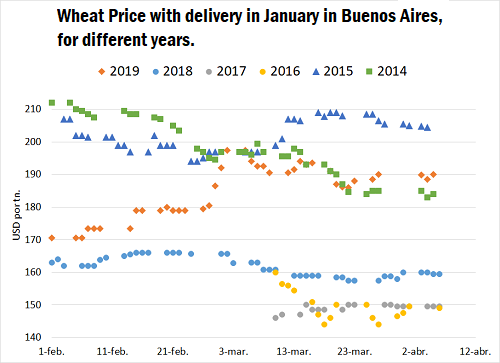
In MATba (Buenos Aires Futures Market), in the prevoius March, the wheat future contracts with December delivery in Rosario averaged USD 187 / ton, which is higher than in previous campaigns. It is not casual that the price of wheat to be planted has risen, taking into account that the month of March 2018 was the driest in the last 50 years, with rains that barely left an average of 17 mm in the core region, well below the historical average of 132 mm. In order to make a comparison with other campaigns, it is interesting to see the price of wheat futures with January delivery in Buenos Aires for different years. If we order the values at this date of the year for the last six seasons, the price at January 18/19 would be ranked second in the record. Thus, the price results attractive for sowing in historical terms.
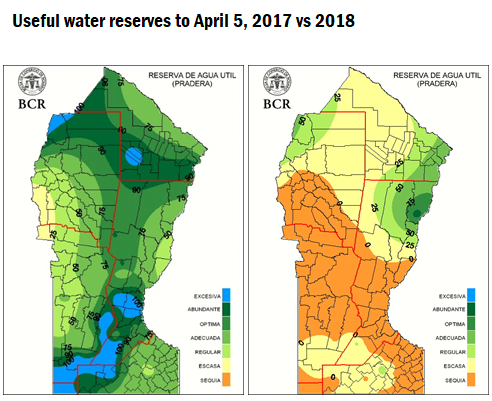
 The strong external demand is added as a bullish factor in prices, putting pressure on the values of both available and next harvest wheat. Leaving aside the economic point of view, climate is the factor that ultimately determines the hectares to be sowed with the cereal, provided it assumes a scenario where good prices are maintained. To the date, according to our intitution't Strategic Guide for Agriculture, the campaign depends on recomposing the soils' water reserves. According to how much and where it rains, from here on, the amount of hectares that are planted with the cereal will be determined. Everything depends on the soil's amount of water at the time of planting. The situation on April 5 of this year is completely different from what happened last year. In 2017/18 sowing of wheat, the water table was high, with excessive water in different sectors. Flooded areas limited the intention of sowing from 5.6 M to 5.43 M ha, while the yield ended up with a record of 33.4 qq / ha with an estimated production of 17.5 Mt. In the current campaign 2018/19 the soils need water before being sown. Without this resource, the Argentine planting area will be resented. Rains and temperatures from now on will draw the final number of hectares to be cultivated. If the soil moisture recovers and, considering the good prices at harvest, there could be an increase in the area sown with respect to last year, close to the planting intentions before the 2017 flooding. Everything relies on the climate.
 Wheat, water and forecasts April had a good start during Holy Week, with average rains of more than 40 mm from the South of Santa Fe to Córdoba and Buenos Aires. Everywhere else, rainfall averaged 20 mm. The replenishment of soil moisture could occur gradually if a continuous pattern of rainfall continues throughout the month of April and May, as long as weekly forecasts indicate widespread rains. The long-term climate In its quarterly climate forecast for the months of April, May and June, the Argentine National Meteorological Service foresees a transition towards a neutral phase of the ENSO phenomenon (El Niño - Southern Oscillation), with a 75% probability of occurrence, leaving behind the stage of La Niña so many complications has brought to our country's crops in recent months.
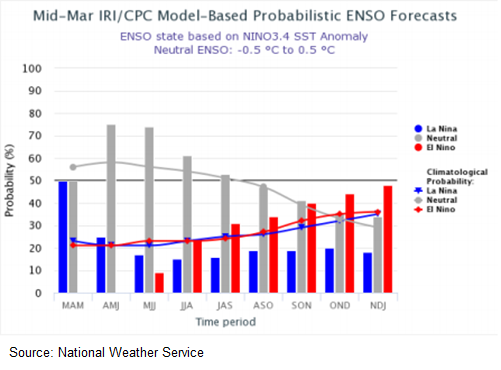 As for rainfall, with a 45% probability in the same period, it is expected that relatively normal levels will be reached in a large part of the provinces of Santa Fe, Córdoba, La Pampa and Buenos Aires. These probabilities are associated with neutral conditions of the ENSO, and the behavior is expected to respond to the climatic probability of each category (33.3%). In conclusion, in a season where prices are attractive, it will be the weather the responsible of the 2017/2018 Argentine wheat campaign success or failure.