Planted area will expand in 2018/2019 for almost all crops in Argentina
SOFÍA CORINA - FEDERICO DI YENNO - EMILCE TERRÉ
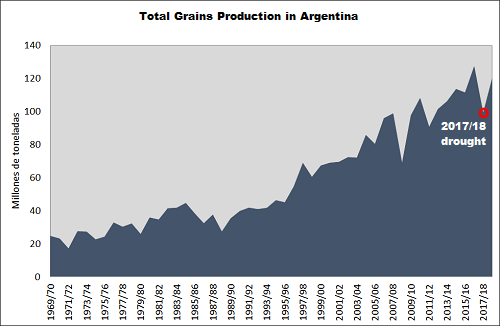
In the 2017/18 commercial year, the planted area of summer crops towards the middle of last year was below the expectations as a result of excess moisture. Ironically, for the summer, fields faced the worst water deficit in 50 years, combined with a season of excess humidity and high temperatures in April, ended up devastating the Argentine total grain production, which fell below 100 million tons to 98.8 Mt, a fall of 22% compared to the previous year.
 The biggest relative falls in terms of production have been suffered by soybeans, which could not complete their sowing plans nor managed to collect the total of the implanted area. In addition, the summer water deficit and the excess of humidity afterwards, sharply cut the yields, which were, on average, 10 quintals per hectare lower than the previous year. Thus, the soybean production barely reached 35 million tons, 40% below the output of the previous year and the lowest volume in almost 10 years, since the fateful drought of 2008/09.
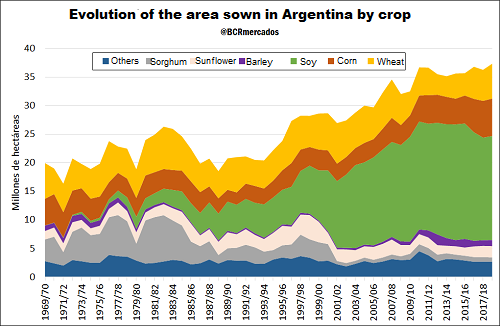
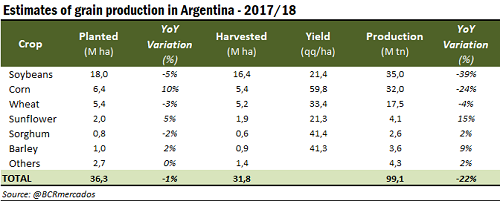 Corn, which is also a summer crop, was able to compensate only part of the drop in yields with a greater area sown in 2017/18. Although this did wasn't sufficient to cover 100% of the planting intentions, it was above what was planted in 2016/17. Thus, despite the fall of 20 quintals in its average yield to just 59.5 qq / ha, production fell by 25% compared to the previous year. In the case of the main winter crops, wheat obtained a record yield of 33.4 quintals per hectare for the second consecutive year, equaling the previous year's productivity, but the smaller area planted due to the water excesses of winter 2017 cut production by 4% to 17.5 Mt. Meanwhile, barley kept the area planted practically unchanged at the national level, but a good yield allowed it to exceed 300,000 tons the production of the previous year, obtaining a total output 3.6 Mt. On the opposite side, sunflower had a great year, advancing 5% on the covered area and obtaining a yield of 21.3 quintals per hectare that exceeded the 19.5 qq / ha of the previous season as well as the average of the previous 5 years, of 19.6 qq / ha. The national production of sunflower 2017/18 thus exceeded the 4 million tons for the first time since 2007/08. Sorghum, covered a surface just inferior to that of the previous year with 810,000 hectares. However, as the lost area was inferior to the unharvested hectares of the previous year, the volume of production was able to stabilize. The rest of the crops (cotton, birdseed, rice, oats, safflower, rye, rapeseed, flax, peanut, millet and hard wheat), meanwhile, added 4.3 million tons of production, without major changes in the total respect to the previous year. With regard to 2018/19 projections, an increase in the total planted area of the order of 3% is expected to cover 37.3 million hectares, almost 1 million above the previous season. The change would obey, mainly, to the recovery of lots that were outside the 2017/18 productive cycle when the water excesses affected the sowing of wheat and barley and the water deficit subtracted hectares to the coarse grains. Among the crops that would see the most increase their implementation surface are: wheat (+ 12%) and barley (+ 5%), as well as corn (+ 2%), soy (+ 1%) and sunflower (+ 1%). The area sown with sorghum, on the other hand, would fall by 7% while the area destined for other crops could fall by 2%.
 In order to project the production of each crop in the next 2018/19 commercial year, trend yields have been assumed, although the basis for calculation depends on the structural conditions of each market in particular. In corn, for example, we take the trend yield that emerged from the last five years, given that, since then, the late and second varieties have gained preponderance, so taking previous data can diminish the likelihood of the projection. In the case of soybeans, on the other hand, the calculation base is 10 years since it hasn't experienced such a deep change in its productive determinants, although in the future the incorporation of new technology could do so. The results of these yield estimators are summarized in the following table.
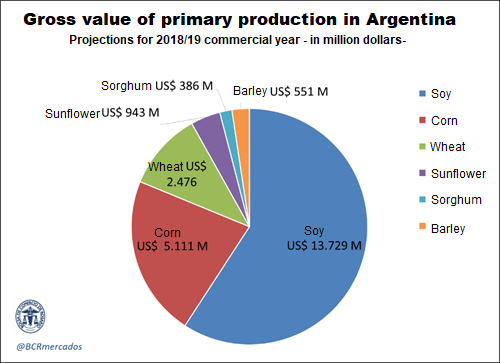
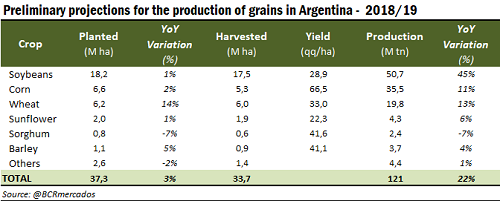 Under the assumptions raised, the total production could reach 120 million tons, 22% more than the previous season and the second highest record in Argentine history, only behind the 127 million in 2016/17. Among the main crops, soybean would recover its place as a star product with about 51 Mt of production, followed by corn with 35.4 Mt. The wheat crop would advance to 19.3 Mt, while the sunflower would obtain 4,3 Mt. The production of barley, meanwhile, would be 3.7 Mt and that of sorghum 2.4 Mt; while the rest of the crops would contribute another 4.4 million tons. As for the gross value of primary production, it could reach US $ 23.2 billion. This value arises specifically from the six main crops (corn, soybean, wheat, sunflower, barley and sorghum) by multiplying the production projected by FAS prices to current harvest. Of the US $ 23,200 million projected, 59% would be provided by soybean with a contribution to the national gross production value of US $ 13,700 million. Maize, meanwhile, would contribute 22% of the total (US $ 5,100 million), and wheat 11% (US $ 2,470 million). The remaining 8% would be distributed among sunflower (US $ 945 million), barley (US $ 550 million) and sorghum (US $ 385 million).
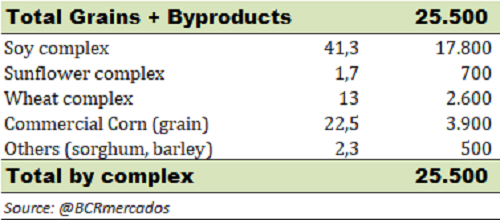
 Finally, potential exports could generate US $ 25,500 million. The estimated figure comes from multiplying the FOB value of the new crop by the amount that will be exported in the new commercial year. The main contribution to the trade balance would come from the soybean complex, responsible for more than 41.3 million tons of exports between beans and by-products, for a total of US $ 17,800 (70% of the total). Maize, for its part, would ship some 22.5 Mt for a total of US $ 3,900 million, or 15% of the foreign exchange income of the primary sector, while the wheat complex would ship some 13 Mt for a total amount around to US $ 2,600 million (10% of the total). The sunflower complex would account for another 3% of the value of exports of grains and derivatives, while the remaining 2% will be provided by barley and sorghum.