
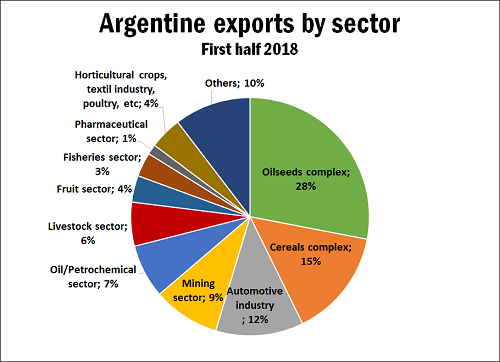
Oilseeds and cereals complexes accounted for 43% of Argentine exports in the first half of the year
DESIRÉ SIGAUDO - EMILCE TERRÉ
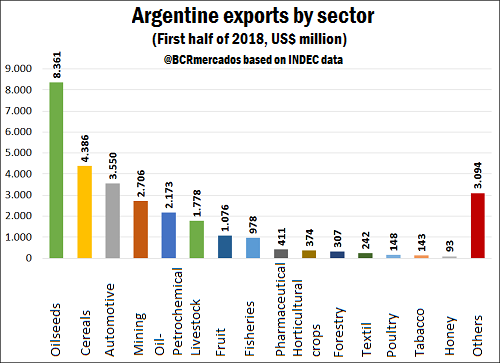
According to INDEC (National Statistics and Censuses Institute) data, Argentine exports during the first semester of 2018 amounted to US$ 29,822 million, 5.5% higher than last year's records. In the first six months of 2018, oilseeds and cereals complexes sales account for 43% of total national exports. Despite their great share in total exports, because of the major drought that affected soybean and corn production last season, soybean and its by-products shipments fell by 14.7% while corn and its by-products increased 15.4% in the same period. Although having a year-on-year fall of more than 20 million tons this cycle, soybean complex continues to be the main exporting sector of Argentine economy. In the first half of 2018, its exports represented 25.3% of the total, but remained 15.5% below last year's figures. Moreover, soybean meal and pellets shipments are 63.8% of the complex's total exports; soybean oil is 18.7%, biodiesel 7.4% and soybeans 6.8%.
 Agribusiness exports in the first six months of 2018 are only 6.3% lower than last year's shipments. However, it can be expected for them to fall further in the second half of the year because of tighter supply due to weather adversities that damaged the crops. The exports of some of the most relevant products from both oilseed and cereals sectors suffered a significant drop during the months of July, August and September. Thus, soybean complex exports in the first three months of the second half of the year had a year-on-year fall of 25% in dollars. While the drop is even more significant if measured in tons: 32%. As for corn, which is another crop that has been very much affected by weather adversities this cycle, its shipments in July, August and September fell this year by 3% (in dollars), and 17% in tons. Finally, wheat exports in the studied period fell by 2% (in dollars) and 27% in tons.
 The amount of shipments is expected to increase in the first half of 2019. Although the intended planted area would be greater than last year, investment on inputs is highly conditioned by high interest rates that limit credit for farmers. Regarding external demand, serious productive problems in some of the main producers worldwide enhance new commercial possibilities for Argentine crops. Corn exports could reach a new record next year due to favorable conditions. Meanwhile, soybean exports might grow as soybean meal and oil shipments are likely to fall amid China-US trade tensions. Moreover, US record harvest and good planting pace in Brazil will contribute to enlarge global soybean stocks, which might push prices down. Agro-export sector (soybeans, soybean meal and oil, biodiesel, corn grain, wheat grain and meal) would contribute with US$ 25,500 million in 2018/19 cycle, around 15% above current cycle's estimated exports. In addition, this volume of exports would translate in US$ 5,700 million of export duties. Argentine grain exports is projected, which could even be on track to break the previous historical record. For the soybean, on the one hand, the traction of the Chinese demand could have repercussions in a rise in the export of beans, to the detriment of flour and oil, of greater added value. On the other hand, the prospect of a record harvest in the United States and a decided advance of the plantations in Brazil point to a strong rise in the stock of beans worldwide, which could have an impact on prices.