Last week, corn prices evolved better than soybean ones
FEDERICO DI YENNO - BLAS ROZADILLA - EMILCE TERRÉ
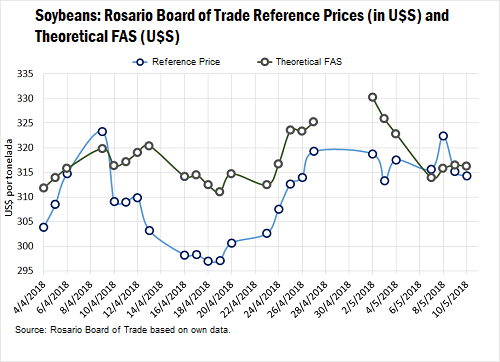
The need to originate merchandise to complete the scheduled shipments from the "Gran Rosario" ports boosted the local grain´s value. As of Thursday, the Rosario Board of Trade's corn reference prices registered a weekly increase of 2% up to AR $ 4,080 / t, while for soybeans the price was at AR $ 7,100 / t , 1.05% below the previous week. The rise in the prices offered by the cereal allowed to sustain a hectic trading activity in our local Physical Market over the last week, including a wide variety of forward contracts, with delivery dates reaching July 2019. For the oilseed, the transactions fluency is affected in the spot contracts by complications caused by the last weeks´ rains. On the other hand, forward contracts negotiations are being affected by the volatility in the financial markets. Producers are demanding bigger prices to deliver their grain, but the industries' margins are not increasing much, thus they are facing difficulties to improve their offers.
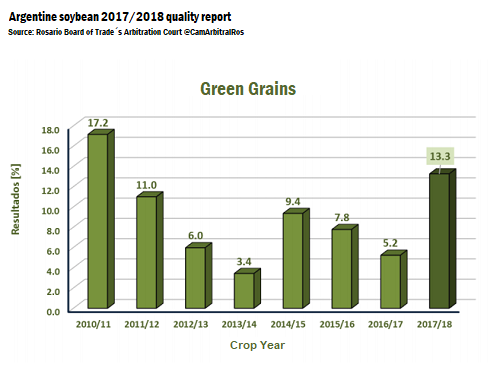
 Regarding the rains, they are delaying the coarse grains harvest, increasing their exposure to diseases and complicating traffic on rural roads. In this regard, a quality report on 119,000 tons of soybeans analyzed by the Rosario Board of Trade´s laboratories reported on previous week that 42.5% exceeded the green beans' tolerance limit of 10%. On average, the incidence of green beans is the highest since the 2010/11, as shown in the attached graph.
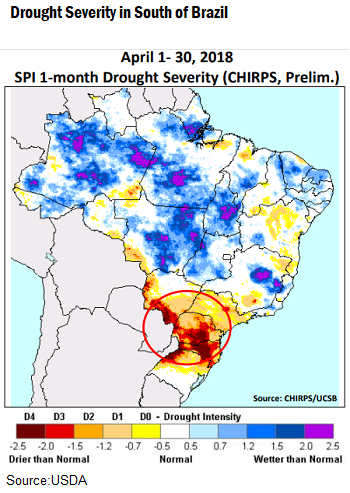
 In relation to corn, given that the late-planting varieties were the most affected by the dry summer´s dry conditions, it is feared that the current rainy conditions continue adding hectares to the lost area, while exposing the plant to diseases that affect the grain´s quality. Simultaneously, the safrinha in Brazil concentrates the attention of the global operators for the continuity of the dryness in southern key regions. Between the states of Paraná and the south of Mato Grosso do Sul, conditions continued to worsen during the week, reducing the yield potential. The attached map prepared by the USDA shows the evolution of drought conditions in the region during the month of April, showing the severity of the situation in one of Brazil´s most productive regions.
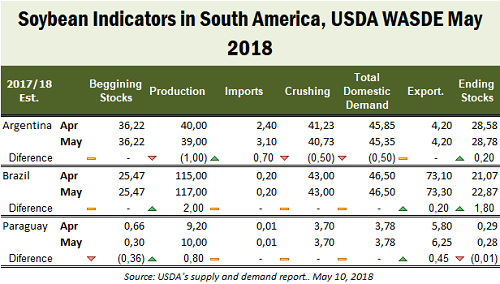
 If South America provides less corn than expected between the months of July and August, the pressure on the US supply increases and hence the relative appreciation of the cereal during the previous week in relation to soybeans. As of Thursday, the nearest corn future in the CBOT had shown a range bound trend while soybeans lost 3% of its value. It should be borne in mind, according to the USDA, that the United States are preparing to plant less corn than soybeans for the first time in their history, reinforcing the cereal´s uptrend. As reported on Thursday, the hectares to be covered with corn would amount to 35.6 M ha, while soybeans would be planted with 36.0 M ha. On the other hand, the agency projected final stocks for soybeans for both the United States and the world well below the market estimates. The operators expected inventories 2017/18 by 14.72 Mt in the US, while the data published by the USDA was 14.42 Mt. These lower stocks in the United States are given by a better processing of US factories in the current crop year. For the 17/18 marketing year worldwide, the final stocks market estimate was, on average, 90.52, but the report published them at 92.16, a few tons higher than expected in this case. One of the reasons was a higher estimated production in Brazil, which would reach a record production. The interesting thing about this correction of 115 Mt to 117 Mt is that it will not go to higher exports of this country, but will increase the final stocks of soy in Brazil, boosting the global final stocks. On the other hand, Argentine soybeans production was revised downward to 39 million tons, and the imports for processing increased to 3.1 Mt.
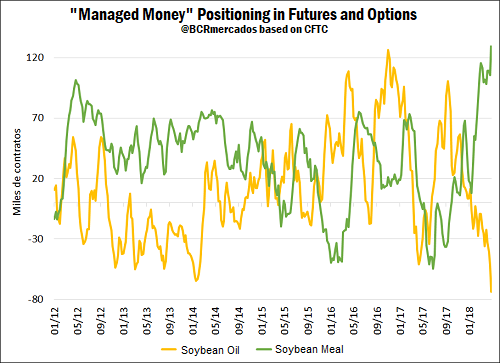
 In the case of corn, a fall in US production is expected for 2018/19, more than proportional to the decrease in consumption, which would reduce the stocks in relation to the current campaign. At a global level, there is a similar scenario. Funds in Chicago are betting on a rise in flour and a drop in soybean oil In this section we will analyze how large funds are operating in the CBOT. According to the latest report from its regulatory agency, at the beginning of May these maintained a record net long position in soybean meal and a record net short position in soybean oil. At that date, the investment funds or "Managed Money" held a long position in soybean meal for more than 12 million tons. This bet to the rise of the by-product began with the drought that affected the development of the Argentine crop in the austral summer and accentuated with the rains of the last weeks. At the same time, the short position in soybean oil reached a net sold position of more than 2 million tons, sustained by the crushing activity in the United States and the generalized weakness in the global vegetable oil markets.