
The industry also suffers the drought: Soybean crushing in April is the lowest of the last decade
SOFÍA CORINA - FRANCO RAMSEYER
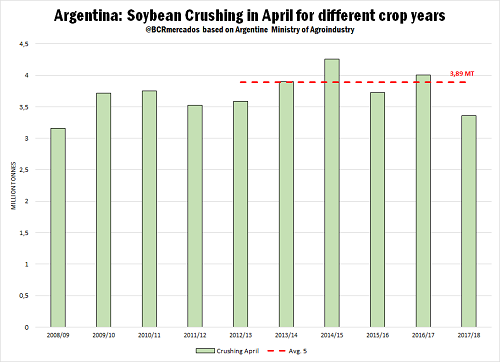
In our Country In the Physical Market of Grains of our institution, soybean prices fell 2% in the previous week. Furthermore, there is a gap between the prices offered by buyers and those expected by sellers, thus, there is not much commercial activity. Factories and exporters find it difficult to improve purchase offers, given that current prices exceed their theoretical payment capacity. The fall in soybeans' production due to the drought and the excessive humidity afterwards make it difficult for the factories to originate merchandise, reporting a total crushing of 3.3 million tons in April, the lowest since the 2008/2009 (year when also a strong drought decimated local production). In addition, as can be seen in the graph below, the volume processed is 13% below the average of the last 5 years for this month.
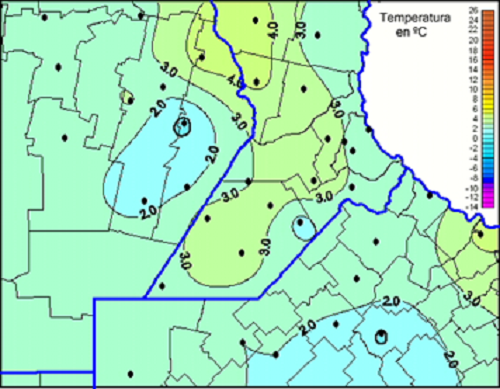
 Climatic issues in Argentina The few to no rainfalls registered during the previous week were a relief for the soils in our country. The first frost of the year contributed to lower the humidity of the grains and slowly resume harvesting. As can be seen in the following map, the minimum temperatures approached the 2 degrees on Tuesday 22/5. According to official statistics, the advance of the soybean harvest exceeds 70% of the national area while for corn the portion of harvested area is 47%.
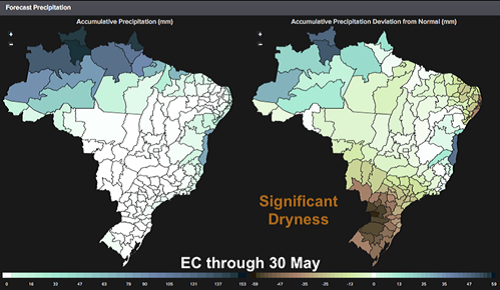
 However, the excessive humidity and high temperatures in April are evident as the harvest progresses. The prospects of production of both crops are adjusted again to the downside by the shattering and weight loss of the grain, especially for soybean crops, that could fall to around 35 million tons. For corn the loss is more limited and the average projections of the market are located at 31.7 Mt. Good news is that drier conditions are expected until next Sunday and in general for this second half of May; scenario that will allow a more fluid advance of the harvest. And in the other countries? The situation is not easy either in our neighbor Brazil, where the drought that is hitting the states producing second corn (safrinha) in the south of the country complicates production expectations. This led the agency Safras to cut its estimate for safrinha production this year to 48.7 million tons, 16% less than what was estimated last month and 27% less than that produced in 2017. This decline is worrisome considering that, in general, second-season corn contributes the greater part of the total production of the Brazilian cereal (in the previous crop year, approximately 70% of the total produced was second-planting corn and only 30% first-planting corn). An additional problem is that, according to specialists from Thomson Reuters, a significantly dry and hot weather will predominate in the mentioned area until May 30, which can negatively impact second-season corn since it is a month in which they go through their periods of pollination and filling of grains, of critical importance for the yields definition. The map below, prepared by Reuters, gives an account of this situation.
 If this scenario materializes, Argentina could be favored with a greater demand for export of corn by the countries that are undersupplied by Brazil, given the reduction in their supply. But in our country the loss of production left by the water deficit last summer puts a ceiling on the possibilities of being benefited by this context.