
Argentine biodiesel seeking for new customers
JULIO CALZADA - FRANCO RAMSEYER - EMILCE TERRÉ
On the other hand, in the information provided by the Argentine Ministry of Energy and Mining, in the first quarter of 2018 biodiesel sales were informed to several countries in an attempt to atomize and diversify our exports: The Netherlands (150,000 tons), Malta ( 119,000 tn), Peru (11,200 tn) and Holland (10,000 tn). In the case of Canada, this northern country has a small biodiesel market, but it is under development. With its extensive territory, it is one of the nations with the lowest population density in the world, with approximately 4 inhabitants per square kilometer. Being a country with very low temperatures, it faces particular needs for the consumption of biodiesel. To understand this, it is worth mentioning that soybean oil - an input that is used in our country for the production of biofuel - contains glycosides that crystallize in very cold climates, which means that the final product cannot be used in certain engines. Therefore, Canada requires a distilled biodiesel, which means it must have gone through a process of exposure to high temperatures, in which harmful particles are eliminated, obtaining a better quality product. Argentina has a company with a biodiesel distillation tower, but there are also some industries that carry out distillation through a less expensive alternative process. It is interesting to look at Canada's complete balance sheet, published by the United States Department of Agriculture in its annual biofuels report.
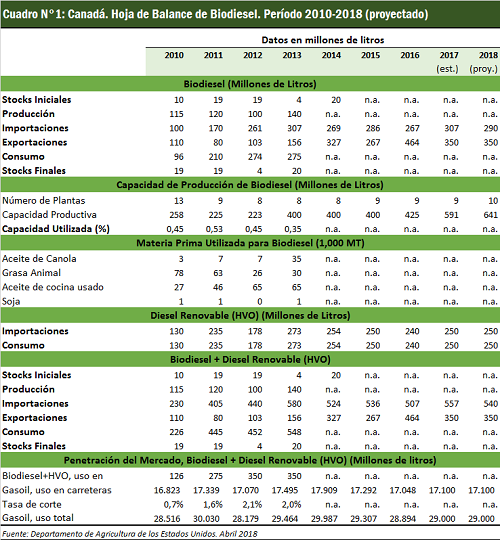 Some relevant data mentioned in the report are the following: First, volumes produced by Canada are low, in fact, Canadian biodiesel production capacity has remained well below domestic demand since 2011. In spite of this, production is expected to grow driven by both federal and provincial active policies that promote the development and consumption of renewable energies and biofuels, seeking to reduce carbon dioxide emissions. There is no specific estimate of production given that the Ministry of Environment and Climate Change of that country does not provide official data since 2013. On the other hand, the USDA report states that -for the moment- the storage capacity of biofuels in Canada is limited, which prevents producers from having large stocks. By 2018, it would increase its capacity by 50 million liters compared to the previous year, reaching 641 million thanks to the expansion of an existing plant and the acquisition of a new one. Regarding the inputs used for its elaboration, it is observed that in 2013 - the last official information - almost half of the Canadian biodiesel was produced based on used cooking oils, while the remaining balance was divided between canola oil and animal fat, with a marginal share of soy. In relation to international trade, in recent years Canada exported most of its production to the United States in response to some policies of the neighboring country favorable to Canadian producers, such as the existence of a tax credit (that expired at the end of of 2016, which explains the decrease in exports in that year). Canada imports sufficient volumes of biodiesel to meet provincial blending requirements (which will soon be eliminated, pointing to a carbon intensity approach that replaces the current minimum blending requirement scheme). Since 2013, its level of imports has hovered around 290 million liters per year (approximately equivalent to 250 thousand tons), and it is not expected to change in 2018, as said in the report. The following chart illustrates Canadian imports and exports, based on the previous table. A conversion was made from liters to tons, assuming a weight of 0.875 grams per cubic centimeter.
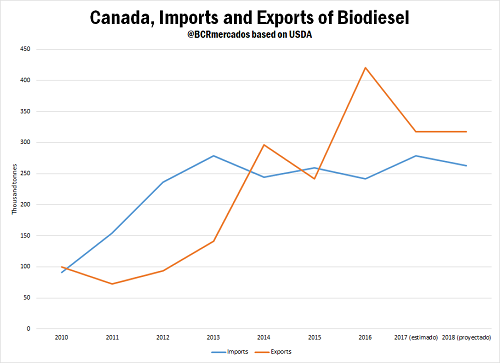 It can be seen that, even if Canada made all its international biodiesel purchases to Argentina, the almost 300 thousand tons would be well below the 1.5 MT acquired by its neighboring country - United States - in 2016. But everything contributes. As we said before: Argentina needs to diversify and atomize its clients' portfolio. This is the challenge for the current year and for the future.