Agricultural producers were left without 30 Mt of grains to sell; a hard blow for them and for the Argentine economy.
PATRICIA BERGERO - JULIO CALZADA - EMILCE TERRÉ
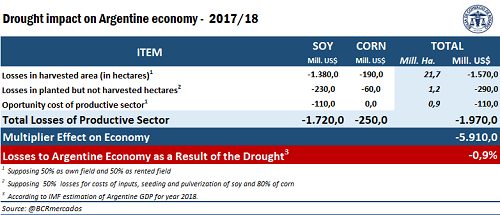
- The drought that hit the Argentine core region ("Región Núcleo") in the summer of 2017/18, the worst in 50 years, destroyed the coarse grains production. Lots that have been left unseeded, increase in the abandoned areas, yields well below normal meant losses of almost 18 Mt in soybeans and 10 Mt in maize, a heavy blow to the outstanding activity of the Argentine economy. When towards mid-April the first rains were received, cutting the dry pulse of the previous weeks, the spirits improved but only for a short time. The humidity did not wane for weeks, and in combination with the high temperatures until mid-May, generated a germinating effect that sprouted what still remained to harvest of soybeans and corn, giving one final hit to the campaign. Production estimates fell 30 million tons of soybeans and corn. - At today's prices, that tonnage means that the producers lost gross income by 7.5 billion dollars between the 20 million tons (Mt) of soybeans and the 10.5 Mt of corn left behind. - Those losses generated tensions and worries throughout the commercial and payment chain of the sector. Without this merchandise (The 30 Mt), Argentina resigned a foreign currency income for exports of US $ 8,000 million. This is equivalent to about 14% of the total exported by Argentina in 2017 (US $ 58,428 million) and 30% of the currencies that entered in 2017 due to foreign sales of grains, flours and oils (the main export complex of our country). - Disaggregating the previous number, in 2018 Argentina would lose the possibility of exporting: 11 Mt of soybean meal, its main product in terms of exports. 2 Mt of soybean oil. 3 Mt of soybeans. 10.3 Mt of corn in grain. - The collectors, cooperatives, transporters, brokers, cereal delivery companies, local banks, suppliers of inputs, vehicles, machinery and equipment, as well as service stations, mechanics and the rest of the economic agents who work closely linked to the field or live thanks to agricultural activity, they will suffer a sharp fall in their income due to the decline in economic activity in general, both commercially, industrially and in services. According to our estimates, computing this multiplier effect, the Argentine economy loses close to US $ 6,000 million, or 0.9% of the GDP estimated by the IMF for the year 2018. - The agricultural producers expected to have that 30 Mt of additional merchandise to sell. Now they must wait for a good wheat campaign to partially compensate for their losses and to bet everything on the coarse harvest of the next crop year.
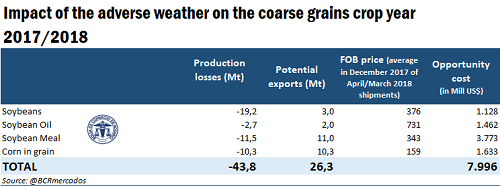 Among the many pernicious effects of the drought, ranging from the drastic reduction of producers´ income to tensions in the payment chain and lower activity of the adjacent industries, the volume of exports is counted among one of the key figures that currently suffers the dry summer and wet autumn consequences. In relation to this, it should be remembered that export volume is usually called exportable balance, since the demand is more flexible in relation to other demands. In other words, when production falls normally the demand that will lower is the external one, while domestic demand will continue to be supplied. The lack of rainfall in the Argentine core zone last summer brought with it losses for almost 20 million tons of soybeans and another 10 million and a half of corn, in relation to the production expected at the beginning of the plantings. In the case of soybeans, the initial expectation was to produce 54.5 million tons, while corn would add another 42 million tons. As a consequence of the water deficit, the production estimate of the oilseed was adjusted to 37 million tons, while the conditions too wet at the end of April and beginning of May would cause an additional cut of 1.75 million tons to date. Thus, the losses amount to 19.25 Mt. For the cereal, a reduction of 10.3 Mt is calculated up to 31.7 Mt. While in the case of corn it can be assumed that all the export could have been made as grain, for soybean it is assumed (in line with the average of the last 10 years) that 15% would be exported as a bean and 75% would go to processing. Soybean crushing, in turn, yields 19% oil and 80% flours, of which 65% of the oil and 93% of the pellets are exported, respectively. Thus, under normal conditions, Argentina could have shipped some 3 million tons of soybeans, plus another 2 Mt of soybean oil and 11 Mt of soybean meal. To value this loss in foreign currency, the average prices for the month of December 2017 are taken for shipments to harvest (March / April 2018). The reason for valuing the opportunity cost, to the prices that were prior to the production cuts, is that they would not have shown the increase they had if the output had not fallen drastically. It can be observed that the cut of almost 20 million tons to the production of soybean means that Argentina loses a total income of foreign currency for more than US $ 6,300 million for soybean complex exports, while corn adds another US $ 1,600 millions that stop entering. In sum, the opportunity cost for the Argentine macroeconomy as a consequence of the decimated production of coarse grains in the 2017/18 commercial year implies resigning an income of US $ 8,000 million for exports. If we consider the current theoretical FAS prices for soybeans and corn, the agricultural producers lost gross income of about 7.5 billion US dollars. If we value this loss production at the FAS prices of mid-December 2017, we obtain a value of gross receipts of 6,300 million U $ S. As for the cost for domestic economic activity, the price increase of the last weeks is not enough to compensate the producer for the quantity losses, resulting in a net loss of US $ 2 billion only for the primary sector. This net income fall is the result of the sum of the lower yield obtained in hectares harvested, the expenses of planting lots that could not be harvested, and the opportunity cost of the lands that were left out of the productive system. In turn, the lower income of the producing sector will result in fewer freight, less activity in the stores, contractors, brokers, banks, among other associated activities. By computing a multiplying factor of three, as suggested by the specialized literature, the global loss for Argentine economic activity can be estimated at US $ 5.9 billion, almost 1% of the GDP estimated by the International Monetary Fund for our country in 2018.