
By 2026, there would be growth in the grain charges transported both by bitrains and traditional trucks
Traditional trucks that arrived in 2017 to all the Argentine port nodes of grains: 2.5 million trucks.
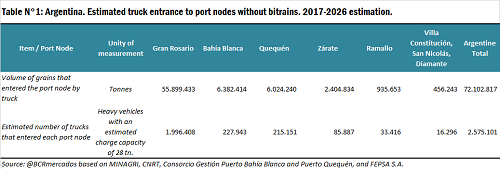
In 2017, without the use of bitrains, the six Argentinian grains´ port nodes would have received trucks with about 72 Mt of grains (Table N ° 1). The most important node is Gran Rosario, which would have received about 56 Mt of grain per truck. The second place is held by the Bahía Blanca port node with almost 6.4 million tons. Very close to this position appears Quequén with 6 million tons.
According to our estimates, last year, there were about 2,575,000 trucks entering the six Argentine grains´ port nodes. There are 5,150,000 trips - round trip - throughout the country, only with grains by truck. We are not considering other truck movements such as those that transport biodiesel to oil refineries, or those that carry vegetable oils to biodiesel plants.
Of those almost 2.6 million trucks, close to 2 million would have entered the Gran Rosario: 76.4% of the national total. Approximately 228,000 trucks could have entered Bahía Blanca and 215,000 heavy vehicles in Quequén.
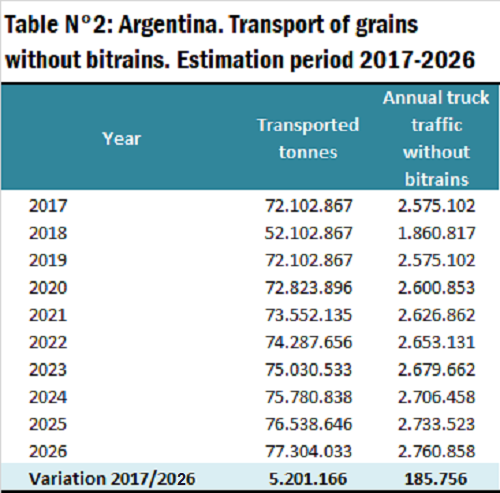
In this scenario we have projected how the number of trucks that transport grain could evolve without the introduction of bitrains. It can be seen in table N ° 2. The situation proposed for this scenario in the next 10 years is as follows:
a) It is expected that there could be a drop in the grain load transported by 2018 in the order of 20 million tons. The negative effects of the drought on the harvests could imply that by 2018 the load will drop nationally from 72 million tons (Mt) to 52 Mt. This could cause the total number of 2,575,000 trucks to fall to about 1,860,000 heavy vehicles. This last value is what we have taken as a granary truck flow for the year 2018.
b) In the year 2019 we assumed that Argentina could transport the same load by truck as in 2017: some 72 million tons. From there, and until 2026, we have considered an annual growth of 1% in the loads transported. By the way, very moderate figure.
Scenario projected to 2026 with bitrains
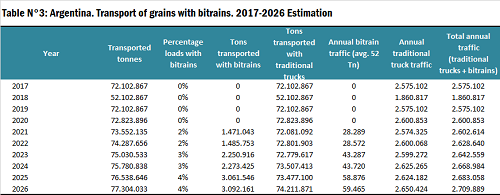
In this scenario (see table N° 3), we have projected how the number of traditional trucks that transport grain could evolve with the gradual introduction of bitrains. The situation proposed for this scenario in the next 10 years would be the following:
a) Due to the effects of the drought discussed above, we have computed that in 2018 the transported cargo will be approximately 52 Mt with 1,860,000 traditional heavy vehicles operating. In 2018 there would be no operations of bitrains transporting granary loads.
b) In the year 2019 we assumed that Argentina could transport the same load by truck as in 2017: some 72 million tons. From there, and until 2026, an annual growth of 1% is planned for the loads transported.
c) We assume that the introduction of bitrains would be gradual from the year 2021, starting with 2% of the total tons to be transported nationally and arriving in 2026 at 4%. Bitrains would transport 52 tons of grains on average per vehicle, while the traditional trucks would transport about 28 tons / average.
Final conclusions:
In order to compare between the two supposed situations (with and without bitrains) table N ° 4 entitled "Estimation of changes in the total number of traditional trucks" is presented.
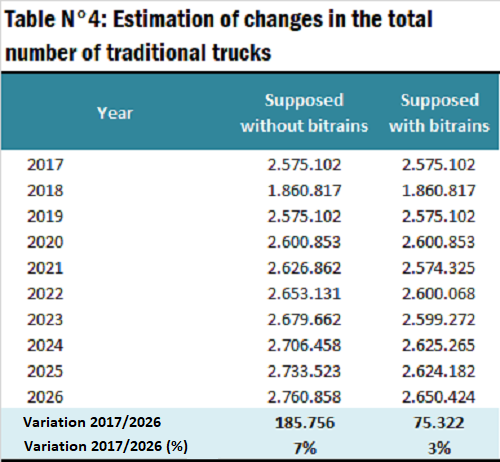
a) Comparing the estimated figures for the years 2017 and 2026 we see that if the bitrains are not introduced, the growth in the number of traditional trucks that transport grain would be 7%. It would go from 2,575,100 in 2017 to 2,760,800 in 2026. There are 185,756 additional traditional trucks that would be added in 10 years.
b) If the bitrains were introduced, comparing the estimated point figures for the years 2017 and 2026, we see that the growth in the number of traditional trucks transporting grain would be 3%. It would go from 2,575,100 in 2017 to 2,650,400 in 2026. There would be 75,300 new trips of traditional trucks that would be added in 10 years.
This shows that there would continue to be growth in the loads transported with traditional trucks in the next 10 years, with the appearance of 59,400 trips with bitrains that would transport 3.1 Mt of grain in 2026. Traditional trucks would transport in 2026 74.2 Mt .
The simulation exercise shows that there are additional loads in 10 years for both the bitrains and the traditional trucks. And this conclusion is reached assuming a low growth in grain production and transport of 1% annual, just after the year 2020. As we said before, by 2026 98% of the trips would be made with traditional trucks and 2 % with bitrains. An important participation of the traditional truck.
The calculations and estimations have been made from the grains transported by truck. This implies that the amount of grains that were or could be transported by rail or barges, have not been included in the analysis. That is to say, the possibility of growth of rail and barge transport is not denied in a growing production horizon, with greater loads for all means of transport.
But the focus has been put on reflecting how a change in the vehicle features (technological improvement) can help, even in a modest percentage, to decrease the total number of vehicles that circulate along the roads and access to the country's industries and port terminals, with the consequent associated benefits in terms of reduction of traffic congestion and emission of gases per tonne-kilometer transported.
We appreciate Mr. Ezequiel Marollo 's collaboration in this note.